
Introduction
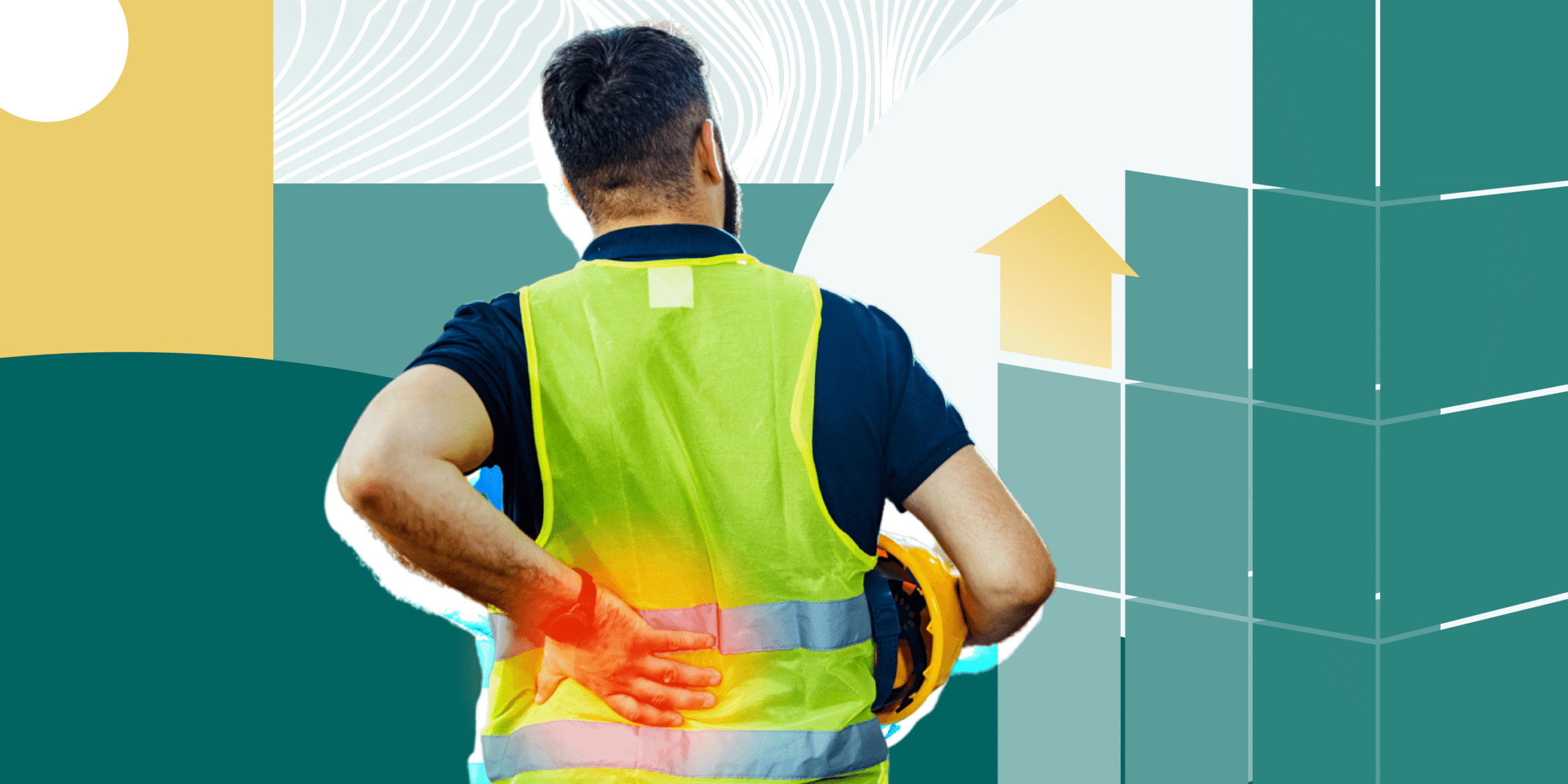
In Singapore, work-related musculoskeletal disorders (WRMSD) accounted for 60% (1000 cases) of all confirmed occupational disease cases from 2019-2021.1 Among WRMSD, back injuries due to ergonomic risks are the most common.1 The top contributing sectors for back injuries due to ergonomic risks include Accommodation and Food Services, Construction, and Transport and Storage.
Table of Contents
ToggleBack injuries due to ergonomic risks are caused by
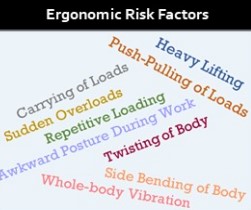
exposure to risk factors such as heavy lifting, push-pulling and carrying of loads, sudden overloads, repetitive loading, awkward posture during work, and twisting/side bending of the body or whole-body vibration, such as when driving heavy vehicles.2 Symptoms of back injuries include a gradual or sudden onset of low back pain, which may be associated with pain radiating down the legs.2
Other than ergonomic risk factors, studies from Germany and Korea have indicated that
environmental and organisational factors can also contribute to higher risk of back injuries.
Environmental factors (noise, air pollution through dust, gases and fumes) and mental stress at work seem to correlate with self-reported back pain in both genders.3 The prevalence of workrelated low back pain was higher in self-employed individuals than in paid workers, and the prevalence was higher in self-employed individuals without employees. This may be due to increased workload or greater exposure to ergonomic risk factors in smaller businesses.4
Impact of Back Injuries/WRMSD
Back injuries and other WRMSD can result in significant, long-term adverse physical, economic,
and psychological consequences, such as residual effects of the injury on daily living, persistent
injury-related anxiety and pain at the end of the workday and significant injury-related financial problems.5 In the US, direct healthcare expenditure for low back pain has been reported to range from $50 billion to $90.7 billion yearly.6 Total costs of direct medical expenditures and loss of work productivity due to low back pain have been estimated to be as high as $635 billion annually.6
Solutions
Although training and education programmes do increase workers’ knowledge of safe behaviour, these efforts alone may not translate into lower rates of back injury.7 A more holistic approach of work organisation and workplace design, integrated with engineering controls, technological solutions and training and education programmes may work better.
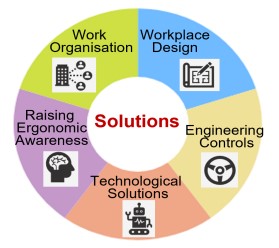
1. Work Organisation
- Better allocation of time/manpower for tasks requiring repetitive handling, to reduce the frequency of manual handling
- Plan work schedules at manageable work pace; include adequate rest breaks to allow employees recovery from muscles exertions
- Rotate workers among different job tasks which use different set of muscles to allow them to spread out the muscle exertions and reduce over exertion of any set of muscles
2. Workplace Design
- Design workplace according to production workflow to reduce travel distances for carrying, pushing or pulling of loads
- Store heavier objects on shelves at waist level if objects are frequently handled2
- Provide adjustable equipment to ensure that workstations are able to fit employees
3. Engineering Controls
- Safe and proper use of lifting and handling aids to reduce physical effort required to handle heavy objects, for examples, powered tugs and trolleys; tracks, conveyors, slides/chutes/ roller balls; adjustable height devices, rotary and tilt tables; mechanical hoists and vacuum lifting devices8
4. Technological Solutions
Currently, wearable devices are widely applied across industries to help improve/complement the level of safety at workplaces. While there are challenges in the adoption of wearable devices, they can contribute to preserving workplace safety through the 4 key functions of monitoring, supporting, training and tracking. One example is the use of exoskeletons to support the musculoskeletal system to prevent damage.9 With further research and development, wearable devices could be an effective way to boost occupational safety and health standards at workplaces and prevent back injuries. Companies that are keen to trial such technological solutions can contact WSH Institute for more information
5. Raising Ergonomic Awareness
- All employees should have a basic understanding of risk factors, common types of WRMSD, control measures and good practices2
- In manual handling jobs where there is high exposure to ergonomic risk or hazards, job-specific training can be implemented for targeted employees
- Training on safe and proper use of mechanical aids and equipment, as well as advice on correct methods of adjustment should be provided
- Easy access to information about good ergonomic practices through posters or infographics to remind workers of proper lifting techniques
- Companies should put in place policies for managing ergonomic risks. Management should communicate regularly with employees about the company’s ergonomic programme
References
[1] Ministry of Manpower (MOM). (2022). Workplace Safety and Health National Statistics
Report 2021.
[2] Workplace Safety and Health Council (WSHC). (2014). Workplace Safety and Health
Guidelines Improving Ergonomics in the Workplace.
[3] Schneider S, Lipinski S, Schiltenwolf M. Occupations Associated with a High Risk of Self-Reported Back Pain: Representative Outcomes of a Back Pain Prevalence Study in the Federal
Republic of Germany. European Spine Journal. 2006 Jun;15(6):821-33.
[4] Kim JY, Shin JS, Lim MS, Choi HG, Kim SK, Kang HT, Koh SB, Oh SS. Relationship between
Simultaneous Exposure to Ergonomic Risk Factors and Work-Related Lower Back Pain: A Cross-Sectional Study Based on the Fourth Korean Working Conditions Survey. Annals of Occupational
and Environmental Medicine. 2018 Sep 5;30:58.
[5] Pransky G, Benjamin K, Hill-Fotouhi C, Himmelstein J, Fletcher KE, Katz JN, Johnson WG.
Outcomes in Work-Related Upper Extremity and Low Back Injuries: Results of a Retrospective
Study. American Journal of Industrial Medicine. 2000 Apr;37(4):400-9.
[6] Yang H, Haldeman S, Lu ML, Baker D. Low Back Pain Prevalence and Related Workplace
Psychosocial Risk Factors: A Study Using Data From the 2010 National Health Interview Survey.
Journal of Manipulative and Physiological Therapeutics. 2016 Sep;39(7):459-472.
[7] Daltroy LH, Iversen MD, Larson MG, Lew R, Wright E, Ryan J, Zwerling C, Fossel AH, Liang MH. A
Controlled Trial of an Educational Program to Prevent Low Back Injuries. The New England Journal
of Medicine. 1997 Jul 31;337(5):322-8.
[8] Health and Safety Executive (HSE). Making the best use of lifting and handling aids. INDG398(rev
1). 2013.
[9] Svertoka E, Saafi S, Rusu-Casandra A, Burget R, Marghescu I, Hosek J, Ometov A. Wearables for
Industrial Work Safety: A Survey. Sensors (Basel). 2021 Jun 2;21(11):3844.